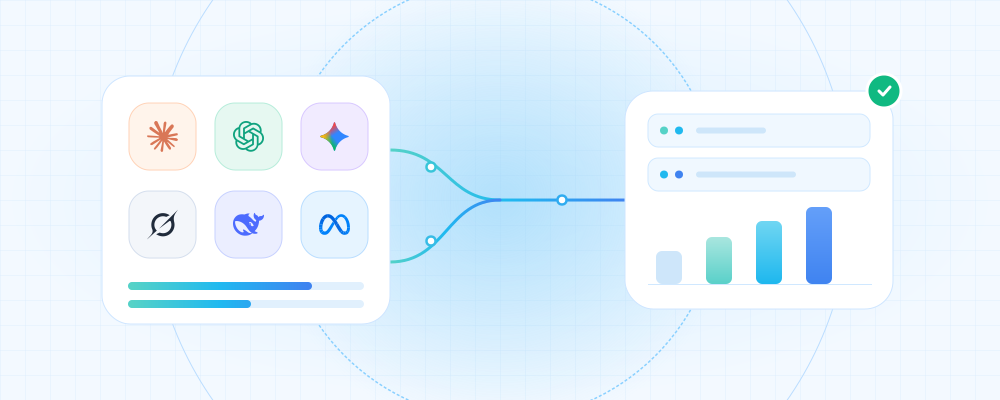
By late 2026, enterprise AI adoption has moved decisively past single-vendor lock-in toward task-specific multi-model routing. Anthropic leads software engineering and long-form analysis with Claude Opus 5.5, OpenAI has transitioned its flagship stack to the GPT-6 family (Astra, Sol, Terra, and Luna), Google dominates million-token native multimodality with Gemini 4 Argon and Gemini 3.8 Flash, xAI delivers high-speed real-time web and agentic workflows with Grok 4.7, while open-weight leaders DeepSeek V4 and Meta Llama 4 have driven bulk inference and private self-hosting costs down by an order of magnitude.
Yet in daily cross-border production, raw benchmark scores are only half the equation. Teams routinely run into regional geo-fencing, OAuth and Stripe billing suspensions, silent model degradation on shared VPNs, and API gateway rate limits. This guide compares the top six AI model families of 2026 across capabilities, subscription and token pricing, onboarding friction, and dedicated proxy network architecture.
Methodology and Pricing Snapshot: Composite intelligence scores reference the Artificial Analysis Intelligence Index (Q4 2026 snapshot), and subscription/token rates reflect official vendor pricing documentation verified in November 2026. Because frontier labs adjust tiers and promotional rates frequently, always benchmark finalists on your own domain prompts before committing production traffic.
1. Side-by-Side Comparison of the Top 6 AI Model Families (Late 2026)
Today's global frontier comprises four proprietary cloud ecosystems (Claude, GPT, Gemini, Grok) alongside two open-weight powerhouses (DeepSeek and Llama). The table below compares their flagship tiers, context windows, subscription plans, API rates, and network access thresholds:
| Model Family and Flagships | Intelligence Index (AA) and Core Strengths | Context Window | Web Subscription Plans | Standard API Rate (per 1M Input / Output Tokens) | Access and Anti-Abuse Threshold |
|---|---|---|---|---|---|
Anthropic ClaudeOpus 5.5 / Sonnet 5.5 | 58 (Opus) / 56 (Sonnet) #1 in agentic coding, GitHub issue resolution, and structured long-form writing. | 1M | Free $0 Pro $20/mo Max $100–$200/mo (includes matching API credits) | Opus 5.5: $4 / $20Sonnet 5.5: $2 / $10Haiku 5.5: $0.10 / $0.50 | Very High Continuous 4-layer trust scoring across native IP registration, SSO reputation, and Stripe billing country. |
OpenAI GPTGPT-6 Astra / 6.1 Sol | 53 (Astra) Best all-round creative output, Computer Use, voice/vision ecosystem, and Codex tooling. | 272K std(higher on extended tiers) | Free $0 / Plus $20/mo Pro 100 / 200 / 500 ($100–$500/mo with API credits) | GPT-6 Astra: $10 / $50GPT-6.1 Sol: $2 / $10GPT-6 Luna: $0.10 / $0.50 | High Blocks noisy datacenter exits; flagged shared VPNs trigger PoW CAPTCHAs, voice drops, and fallback routing. |
Google GeminiGemini 4 Argon / 3.8 Flash | 53 (Argon) Native audio/video/image/code reasoning and best frontier price-to-performance. | 1M | Free tier available Google AI Pro and Ultra regional plans | Gemini 4 Argon: from $4/M in3.8 Flash: $0.75 / $3.75 (intro)Flash-Lite: $0.25–$0.30 in | Medium-High Locked to Google Account country profile; IP region drift triggers unsupported-country blocks. |
xAI GrokGrok 4.7 / Grok 4.3 | 46.5 (Grok 4.7) Real-time X and live web intelligence, fast agentic tool calling, lowest Tier-1 output rate. | 500K (4.7)1M (4.3) | X Plus $8 / Premium $30 Super $100 / Ultra $200/mo | Grok 4.7: $2 / $6 (under 200K)Grok 4.3: $1.25 / $2.50 | Medium-High Coupled to X anti-bot defenses; shared proxy exits trigger Cloudflare and Arkose verification loops. |
DeepSeekV4 Pro / V4.1-Flash | Open-Weight Cost Leader 552B MoE with strong math/coding and 98% off-peak prompt-cache discounts. | 1M(384K max output) | Free web and mobile chat access | V4.1-Flash off-peak: $0.15 / $0.60V4 Pro off-peak: $0.66 / $1.98(2x during UTC weekday peaks) | Low No foreign card barrier and OpenAI-SDK drop-in compatible; watch peak concurrency caps and cross-border latency. |
Meta Llama 4Maverick / Scout | Private On-Prem Standard Native multimodal MoE weights with zero data egress and industry-longest 10M context. | 1M (Maverick)10M (Scout) | Free open-weight download (Meta AI web geo-restricted) | $0 token fee self-hosted; pay-per-token via cloud hosts | Low (API) / High (GPU Ops) Requires local GPU ops for self-hosting or regional static egress for Meta AI and cloud endpoints. |
2. Capability Breakdown: Matching Each Model Family to Real Workloads
Modern rankings depend heavily on the reasoning effort budget configured per request—for example, Claude Opus 5.5 scores 58 at maximum effort versus 54 at standard high effort. Rather than routing every prompt to the most expensive model, high-performing engineering teams split workloads by domain strength:
1) Complex Software Engineering and Long-Form Technical Writing: Anthropic Claude 5.5
For multi-file repository refactoring, autonomous terminal agents in Claude Code, and nuanced analytical prose, Claude Opus 5.5 and the permanent value workhorse Claude Sonnet 5.5 ($2 / $10 per million tokens) remain the benchmark to beat, complemented by prompt caching reads down to 5–10% of base input cost.
2) Creative Production, Computer Use, and Broad Enterprise Tooling: OpenAI GPT-6
OpenAI's GPT-6 lineup segments capability cleanly by unit economics: GPT-6 Astra handles peak frontier reasoning, GPT-6.1 Sol delivers near-Astra coding and computer-use intelligence at one-fifth the token cost ($2 / $10), GPT-6.1 Terra covers visual and everyday business workflows, and GPT-6 Luna ($0.10 / $0.50) powers high-volume classification.
3) Million-Token Audio, Video, PDF Synthesis, and Grounded Research: Google Gemini
When workflows ingest raw video recordings, multi-hour audio transcripts, or massive regulatory PDFs in a single prompt, Gemini 4 Argon and Gemini 3.8 Flash stand apart with native 1M multimodal context and built-in Google Search grounding, plus a generous free developer tier in AI Studio for rapid prototyping.
4) Live Social Sentiment and Cost-Efficient Agent Loops: xAI Grok 4.7
Grok 4.7 combines direct real-time X firehose context with fast tool-use execution and a $6/M output rate below 200K tokens—making it a favorite inside Cursor and Grok Build for rapid iterative coding and live market monitoring.
5) Bulk Data Extraction and Air-Gapped Privacy: DeepSeek V4 and Meta Llama 4
For e-commerce catalog normalization, multilingual review mining, and high-throughput ETL pipelines, DeepSeek-V4.1-Flash cuts off-peak token bills to $0.15 / $0.60 ($0.003/M on cache hits). Meanwhile, regulated finance, healthcare, and legal teams deploy Llama 4 Maverick and Scout on private clusters to process up to 10M tokens without sensitive data ever leaving internal infrastructure.
3. Onboarding Friction and Risk Controls: Why AI Accounts Get Blocked or Throttled
Choosing the right model is futile if your team loses workspace access mid-sprint. Each provider enforces distinct network and identity telemetry checks:
- Anthropic Claude (Strictest Continuous Trust Scoring): Evaluates exit IP purity, non-VoIP mobile verification, browser storage isolation, and strict three-way alignment between login IP registration country, card billing address, and tax region during Pro or Max checkout. Using shared VPNs or cross-border broadcast IPs routinely triggers instant suspension—see our deep dive in Claude Account Registration and Retention in 2026: Understanding the Trust Evaluation Behind Account Suspensions in 10 Minutes.
- OpenAI ChatGPT (Silent Capability Throttling and PoW Loops): Rather than banning every noisy IP outright, OpenAI dynamically degrades untrusted sessions—imposing frequent Cloudflare/Arkose proof-of-work challenges, dropping real-time voice sockets, and restricting peak reasoning quotas when multiple unrelated users share a flagged proxy subnet.
- Google Gemini and AI Studio (Account Country Locking): Access to Gemini Advanced and paid AI Studio tiers is anchored to your Google Account's country association. If your proxy hops across continents or conflicts with your Google Payments profile, requests fail with regional eligibility blocks.
- xAI Grok (Social Graph Anti-Bot Coupling): Logging into Grok via X over datacenter or rotating proxies immediately trips X's automated account-lock and puzzle verification defenses.
4. Practical Proxy Architecture Guide for Multi-Model AI Teams
To keep high-value web subscriptions unbanned while maintaining low-latency API throughput, separate interactive human sessions from programmatic backend traffic using purpose-matched proxy tiers:
| AI Operational Scenario | Target Platforms and Models | Recommended Proxy Tier | Key Configuration Standard |
|---|---|---|---|
Account Creation and Pro/Max Billing | Claude Pro/Max, ChatGPT Pro, Gemini Ultra | Native Static Residential Proxies | Guarantees 100% native IP registration location matching the target country (non-broadcast IP), dedicated single-tenant history, aligned with card billing country. |
Daily Interactive Web and AI IDE Coding | Claude Code, ChatGPT Plus, Cursor, Grok Build | Static ISP Proxies or Native Residential | Hold one fixed residential IP 24/7 with unmetered bandwidth and zero mid-session IP rotation to prevent "impossible travel" flags. |
Multi-Workspace Team and Client Isolation | Separate Claude Projects, regional Google AI Studio accounts | AdsPower Browser + Dedicated Static IP | Enforce 1 Account : 1 Browser Profile : 1 Dedicated Static IP to isolate cookies, IndexedDB, WebRTC, and timezone headers. |
Backend API Gateway Routing and Batch Jobs | OpenAI API, Anthropic API, DeepSeek, Hosted Llama APIs | Datacenter Proxies | Prioritize 10Gbps throughput, millisecond-level routing latency, and fixed static egress IPs for enterprise API allowlisting. |
Three-Step Deployment Checklist for Distributed Teams
- Provision a Clean Upstream Google SSO Anchor: Signing into Claude, ChatGPT, Gemini, and Grok via OAuth transfers far stronger initial trust than disposable email links—provided the Google account itself was cleanly created. Follow How to Register a Commercial-Grade Gmail Account in 2026: Browser Isolation, Static ISP Proxies, and QR Verification to initialize a 2FA-hardened Gmail identity on the exact same static IP first.
- Pin Dedicated Regional Nodes and Audit Leak Hygiene: Select primary Tier-1 AI launch regions such as MantaProxy United States, United Kingdom, or low-latency Asia-Pacific Singapore nodes. Bind the proxy inside your client or integration tool, then verify zero WebRTC/DNS leaks and clean IP reputation via MantaProxy's Free IP Purity Checker before logging in.
- Decouple Human Web Workspaces from API Model Routers: Keep human web accounts pinned permanently to Native Static Residential or Static ISP channels, while routing backend SDK traffic across Claude Sonnet 5.5, GPT-6.1 Sol, Gemini 3.8 Flash, and DeepSeek-V4.1-Flash over high-speed Datacenter Proxies.
Conclusion: Pair Multi-Model Routing with Deterministic Network Infrastructure
In 2026, leaderboard crowns change hands almost monthly, making single-vendor dependence both costly and fragile. The most resilient organizations combine task-aware multi-model routing—using Claude 5.5 for engineering, GPT-6 for multimodal creativity, Gemini for million-token synthesis, Grok for live web intelligence, and DeepSeek or Llama 4 for scale and privacy—with clean, dedicated static proxy infrastructure. Explore MantaProxy Pricing Plans to equip your AI workspaces and API gateways with stable, uncontaminated global connectivity.